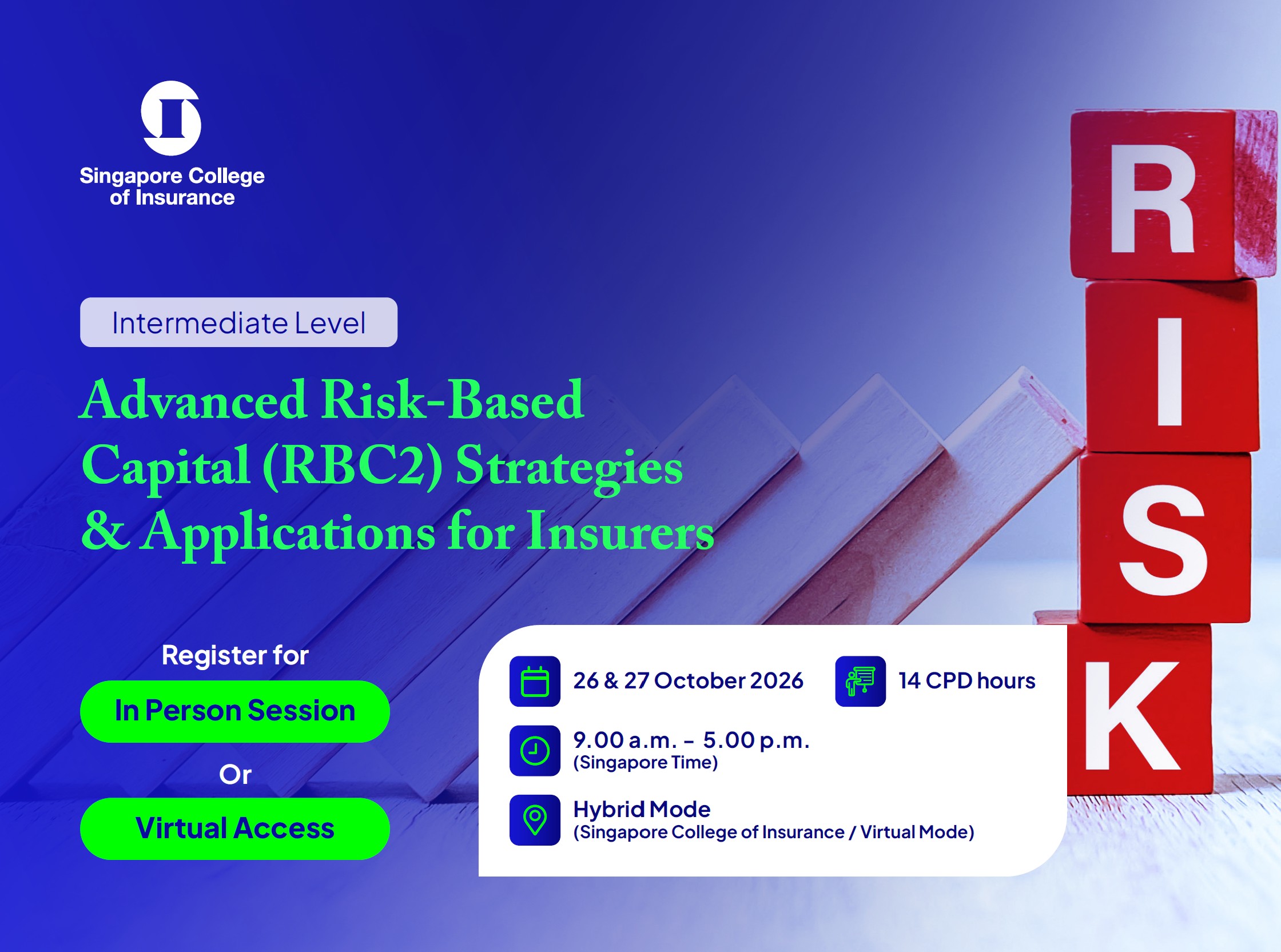
Advanced Risk-Based Capital (RBC2) Strategies & Applications for Insurers (Virtual Access)

Programme Highlights

As insurers continue to operate in a more complex capital, risk and regulatory environment, the ability to understand and apply Singapore’s Risk-Based Capital framework has become increasingly important for senior insurance professionals, actuaries, risk managers, finance teams and business leaders. This two-day programme provides an advanced and practical exploration of RBC2, focusing not only on regulatory requirements, but also on how capital considerations influence solvency management, stress testing, liability valuation, product strategy, reinsurance decisions, asset-liability management and enterprise-wide governance.

The first four modules will be led by Vanessa Lou and Azer Manalad from EY, bringing together actuarial, finance, risk, regulatory, accounting and insurance-sector perspectives. These sessions will examine the technical building blocks of RBC2, including capital modelling, solvency requirements, risk modules, financial resources, stress testing, liability valuation and capital optimisation. Participants will also work through practical scenarios and case studies to strengthen their ability to interpret RBC2 outcomes and translate them into strategic management actions.

Modules 5 and 6 will be delivered by a speaker from an insurance regulator or other relevant entity, providing participants with direct regulatory perspectives on global regulatory alignment, supervisory priorities, governance expectations, risk appetite and industry responses to supervisory challenges. This combination of technical practitioner insights and regulatory perspectives will allow participants to better understand both the mechanics and the strategic implications of RBC2 in the Singapore insurance market.

14 CPD Hours
Mode: Virtual Access
Dates: 26 & 27 October 2026
Time: 9.00 a.m. -  5.00 p.m.

For Whom

This programme is suitable for insurance professionals who require a deeper understanding of RBC2 from a technical, strategic or governance perspective, including:

  • Chief Financial Officers, finance leaders and capital management teams
  • Chief Risk Officers, enterprise risk management teams and ORSA/stress testing teams
  • Appointed actuaries, actuarial teams and valuation specialists
  • Senior management and business leaders involved in capital planning or strategy
  • Product, pricing and portfolio management teams
  • Reinsurance, investment and asset-liability management professionals
  • Compliance, governance and regulatory affairs teams
  • Board members, board risk committee members and senior executives seeking stronger oversight of RBC2 implications

Key Learning Objectives

By the end of the programme, participants will be able to:

  • Explain the key components of the RBC2 framework, including solvency levels, capital adequacy requirements, financial resources and regulatory intervention levels.
  • Analyse the main risk requirement modules under RBC2, including insurance, market and operational risks, and understand how correlation, diversification and aggregation affect capital outcomes.
  • Assess the role of stress testing, scenario analysis, ORSA and reverse stress testing in evaluating insurer resilience under adverse conditions.
  • Understand how liability valuation, discounting, matching adjustments, illiquidity considerations and IFRS 17 interactions can affect RBC2 assessments.
  • Evaluate capital optimisation strategies involving product design, reinsurance, asset-liability management, capital planning and intra-group considerations.
  • Compare Singapore’s RBC2 framework with selected international regulatory regimes, and consider the implications for cross-border insurers and insurance groups.
  • Strengthen the linkage between RBC2, enterprise risk management, risk appetite, governance frameworks and supervisory expectations.
  • Apply RBC2 concepts through case studies, workshops and group discussions involving capital stress, market shocks and supervisory challenges.

Programme Outline

Module 1: Advanced Capital Modelling

This module provides an advanced overview of the RBC framework and solvency levels, including RBC development, solvency requirements, intervention levels, Capital Adequacy Ratio, Financial Strength Ratio, Tier 1 capital and CET considerations. It will examine the detailed risk requirement modules under RBC2, including insurance risks such as mortality, morbidity, dread disease, expense and persistency risks, as well as market risks such as equity risk, interest rate mismatch, counterparty risk and credit spread risk. The module will also cover operational risk, correlation, diversification, aggregation approaches, financial resources, regulatory adjustments, capital add-ons and supervisory interventions.

Module 2: Stress Testing & Scenario Analysis

This module examines the role of stress testing and scenario analysis under RBC2, including MAS expectations on stress testing, Insurance-Wide Stress Testing and ORSA requirements. Participants will explore reverse stress testing for tail risks and consider how insurers can assess vulnerabilities under severe but plausible scenarios. The module will include case study discussions on catastrophic event simulation for life and non-life insurers, as well as a practical workshop on building multi-scenario stress testing models and identifying appropriate management actions.

Module 3: Liability Valuation & Complex Adjustments

This module focuses on advanced liability valuation issues under RBC2, including discounting techniques, risk-free rates and participating fund discount rates. It will also cover matching adjustment, volatility or illiquidity premium considerations, and their implications for RBC assessments. Participants will examine contract boundaries and interactions with IFRS 17, including differences relating to discount rates, expenses and contract boundary treatment. The module will include a workshop on valuation under stressed market conditions, with reference to how RBC results may be affected during and after market stress events.

Module 4: Capital Optimisation & Strategic Responses

This module explores how insurers can use RBC2 insights to support capital planning and strategic decision-making. Topics include capital levels, fungibility and transferability issues, corporate planning, intra-group considerations, product strategy based on RBC considerations, product capital intensity, reinsurance optimisation, governance requirements and the impact of reinsurance on capital outcomes. The module will also examine regulatory and accounting arbitrage considerations, asset-liability management under RBC2 constraints, duration matching, foreign exchange matching, investment risk hedging, participating fund management and unit-linked fund management.

Module 5: Global Regulatory Alignment

This MAS-led module will examine how Singapore’s RBC2 framework compares with selected international regulatory regimes, including the Insurance Capital Standard, Solvency II and China’s C-ROSS. It will consider the implications for cross-border insurance groups, conglomerates and insurers operating across multiple jurisdictions. The session will also provide perspectives on MAS supervisory priorities and emerging regulatory developments relevant to insurers.

Module 6: Governance, Risk Appetite & Case Studies

This MAS-led module focuses on governance, risk appetite and supervisory expectations under RBC2. Participants will examine how insurers can build an enterprise-wide risk and capital governance framework and link RBC2 more effectively with risk appetite statements, ERM frameworks and board-level oversight. The module will include case studies on MAS regulatory reviews and industry responses, followed by a panel discussion or group exercise on how insurers should respond to supervisory challenges.


Programme Leaders

Vanessa Lou leads the ASEAN insurance and actuarial practice for EY. She has nearly 20 years’ experience spanning actuarial work, finance, risk, product development, and large-scale business transformation. Her work with insurers, regulators, and industry bodies throughout the Asia Pacific has given her a well-rounded perspective on market entry strategies, regulatory frameworks, and value creation.

Azer Manalad has more than 20 years of experience in Assurance practice providing professional services to his clients in financial services, primarily in insurance, with some in banking and capital management, wealth and asset management as well as service sectors.  He has been in the Financial Services team of EY Singapore since 2005.  Azer worked for years in other EY offices (New York, Seattle and the Philippines) prior to joining EY Singapore. Azer has extensive experience across Life and General Insurance, as well as Reinsurance sectors. Azer has strong technical knowledge (both insurance and IFRS) and is highly competent in the Singapore financial services regulatory framework

Programme Fee

Singapore-based Participant: S$620.21 (inclusive of 9% GST)

Overseas-based Participant: S$569.00

A 10% Group Discount is also applicable for organisations registering a minimum of three participants.

Register Now
Last Updated Date:
26/8/26

Advanced Risk-Based Capital (RBC2) Strategies & Applications for Insurers

View Brochure