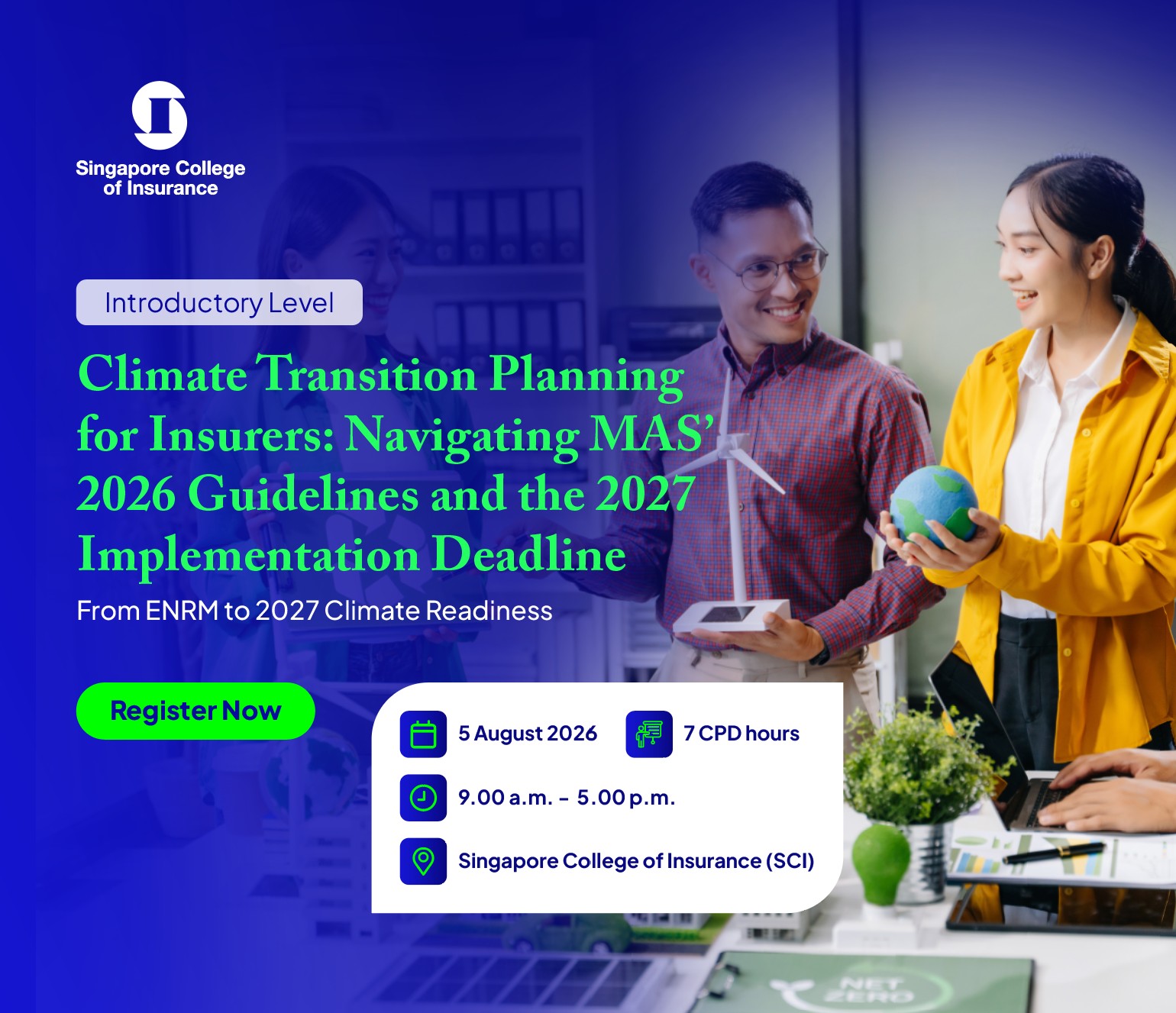
Climate Transition Planning for Insurers: Navigating MAS’ 2026 Guidelines and the 2027 Implementation Deadline

Programme Highlights

The Monetary Authority of Singapore (MAS) issued its updated Guidelines on Environmental Risk Management – Transition Planning in March 2026, strengthening supervisory expectations for financial institutions, including insurers, in managing climate-related and environmental risks.

These enhanced guidelines build upon the original 2020 Environmental Risk Management (ENRM) framework and place greater emphasis on transition planning, governance, underwriting and investment practices, data integrity, and disclosure obligations. Insurers are expected to progressively integrate climate-related considerations into strategic decision-making, risk management frameworks, and operational processes ahead of the September 2027 implementation deadline.

This programme provides insurance professionals with a practical understanding of MAS’ latest expectations and explores how insurers can develop credible, proportionate, and actionable transition plans. Participants will gain insights into managing both transition and physical climate risks while balancing commercial sustainability, underwriting discipline, investment stewardship, and regulatory compliance.

7 CPD Hours
Mode: Face-to-face training
Date: 5 August 2026
Time: 9.00 a.m. to 5.00 p.m.

For Whom

  • Chief Risk Officers and Risk Management Professionals within insurers
  • Underwriting Managers and Actuaries (Life & General Insurance)
  • Chief Investment Officers and Investment Analysts managing insurance portfolios
  • Compliance, Regulatory Reporting, and Governance Professionals
  • Product Development and Pricing Teams
  • Sustainability, ESG, and Climate Risk Leads
  • Internal Audit and Enterprise Risk Management Professionals

Key Learning Objectives

At the end of the programme, participants should be able to:

  • Explain the key enhancements introduced under the MAS 2026 Transition Planning Guidelines compared to the 2020 ENRM framework.
  • Identify and interpret MAS’ supervisory expectations relating to governance, strategy, risk management, underwriting, investment, and disclosure for insurers.
  • Understand physical and transition climate risks relevant to insurance underwriting and investment activities.
  • Understand structured engagement approaches when assessing climate-related risks of policyholders and investee companies without indiscriminate withdrawal of coverage or investments.
  • Explain data gaps, modelling limitations, and the use of transition pathways in climate risk assessments.
  • Understand how to develop a practical implementation roadmap towards achieving compliance by September 2027.
  • Know available industry support mechanisms and legal advisory initiatives supporting climate transition planning and governance

Programme Outline

Session 1: Governance, Strategy & Risk Management

  • Regulatory Context & Evolution of MAS Climate Risk Expectations
    • Evolution from the 2020 ENRM Guidelines to the 2026 Transition Planning Guidelines
    • Key enhancements and supervisory expectations introduced by MAS
    • Overview of the 18-month transition period leading to September 2027
    • Insights from MAS consultation papers and industry responses
  • Scope and Application for Insurers
    • Governance and strategic integration of environmental risks
    • Risk management expectations for insurers
    • Underwriting and investment considerations
    • Disclosure obligations relating to environmental risk information
  • Governance, Board Oversight & Strategic Alignment
    • Board and senior management responsibilities
    • Embedding transition planning into insurer business models
    • Aligning governance frameworks, policies, and contractual arrangements
    • Regulatory reporting and accountability considerations
  • Managing Physical and Transition Risks
    • Understanding physical climate risks:
      • Extreme weather events
      • Floods and catastrophe exposures
    • Understanding transition risks:
      • Carbon pricing mechanisms
      • Regulatory and policy changes
      • Stranded asset considerations
    • Balancing risk management with responsible market participation
    • Avoiding indiscriminate withdrawal of insurance coverage

Session 2: Underwriting, Investment, Data & Disclosure

  • Integrating Climate Risk into Underwriting Practices
    • Assessing climate vulnerabilities of policyholders
    • Sectoral transition and decarbonisation pathways
    • Use of jurisdictional and industry transition roadmaps
    • Structured client engagement and transition support strategies
    • Underwriting considerations without abrupt coverage withdrawal
  • Climate Risk Integration in Investment Portfolios
    • Managing environmental risks within insurer investment portfolios
    • Climate-related investment governance and stewardship
    • Engagement with investee companies
    • Alignment with portfolio risk management and sustainability objectives
  • Data, Modelling & Environmental Risk Disclosures
    • Addressing data gaps and modelling limitations
    • Improving data quality, governance, and scenario analysis capabilities
    • Use of proxies, assumptions, and transition pathways
    • MAS expectations relating to environmental risk disclosures
    • Emerging reporting and transparency considerations
  • Implementation Roadmap Towards September 2027
    • Developing a practical 18-month implementation plan
    • Suggested phased approach:
      • Governance enhancement
      • Underwriting pilots
      • Investment portfolio reviews
      • Disclosure preparation
    • Internal capability building and stakeholder engagement
    • Overview of available support initiatives, including:
      • Sustainability Legal Catalyst Programme
      • Legal advisory support for environmental governance initiatives

Programme Leader

Raymond Cheung is a seasoned C-suite executive and Chartered Actuary with over 20 years of experience across insurance, ESG, and capital markets. He is CEO of CER Consultancy, delivering ESG training. He was formerly Group CEO of Basel Medical Group (Nasdaq: BMGL) and held statutory Chief Risk Officer roles at AIG Asia Pacific and Asia Capital Reinsurance Group. As Regional Insurance Lead at Grab, he designed digital insurance programs across eight ASEAN markets. He serves as Independent Director for SGX- and Nasdaq-listed companies and is an accredited trainer for SMU Academy and the Singapore College of Insurance.

Programme Fee

Full Course Fee: S$414.20  (inclusive of 9% GST)

A 10% Group Discount is also applicable for organisations registering a minimum of three participants.

Register Now
Last Updated Date:
16/6/26

Climate Transition Planning for Insurers: Navigating MAS’ 2026 Guidelines and the 2027 Implementation Deadline

View Brochure