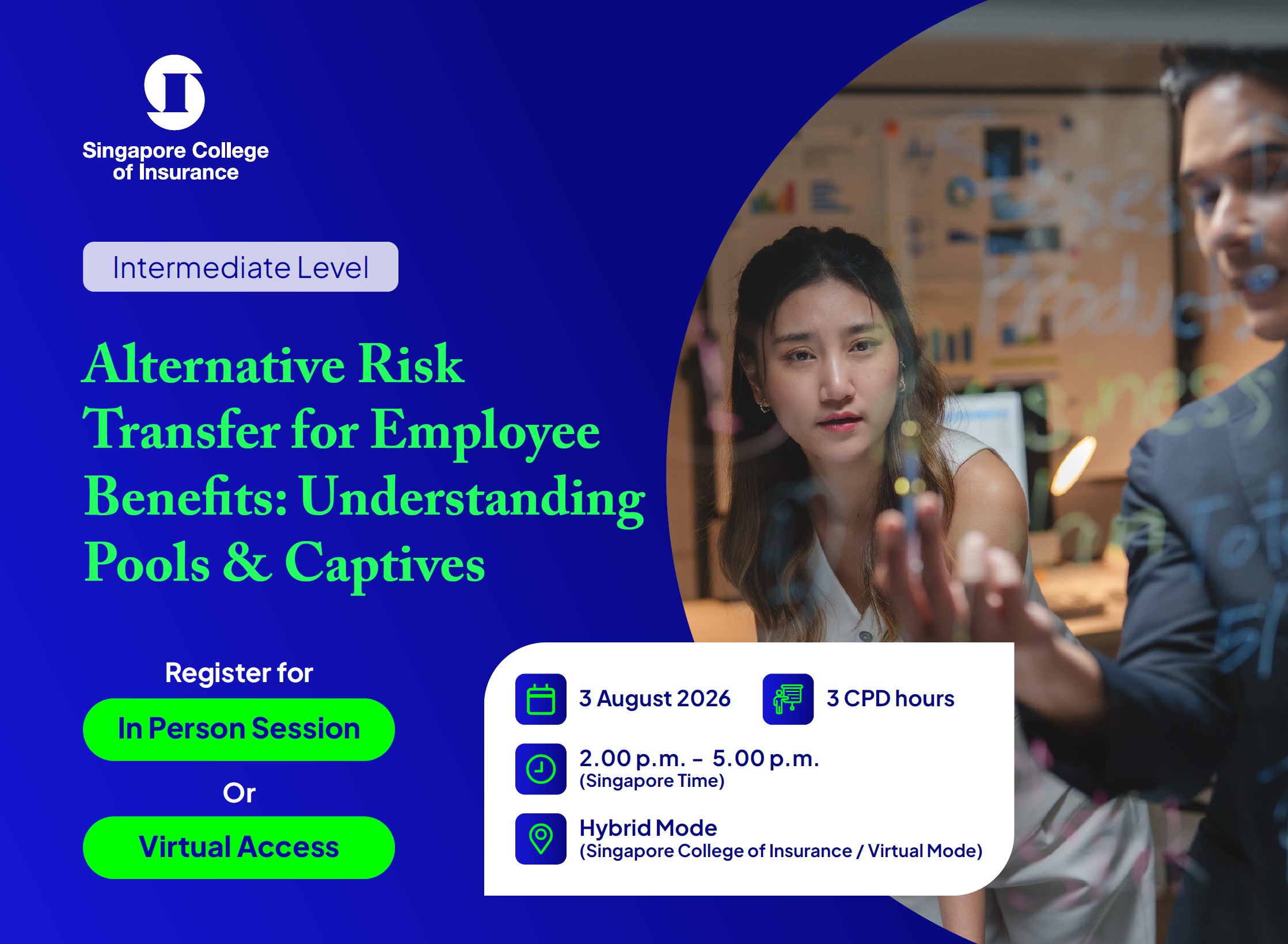
Alternative Risk Transfer for Employee Benefits: Understanding Pools & Captives (Virtual Mode)

Programme Highlights

Rising healthcare costs and evolving multigenerational workforce needs are reshaping how organisations fund employee benefits. This session explores how alternative financing strategies—such as multinational pooling and captive solutions—can unlock greater control, efficiency, and sustainability.

This session challenges conventional thinking by exploring Alternative Risk Transfer (ART) strategies—multinational pooling and captives—unlocking greater precision in how benefits are structured and funded, organisations can deliver more relevant, personalised, and meaningful benefits that better align with diverse workforce needs—strengthening engagement, wellbeing, and retention.

3 CPD Hours
Mode: Virtual Instructor-Led training
Date: 3 August 2026
Time: 2.00 p.m. -  5.00 p.m.

For Whom

  • HR and Rewards Professionals
  • Employee Benefits Specialists
  • Insurance and Employee Benefits Brokers
  • Corporate Risk Managers
  • Finance and Treasury Professionals
  • Captive Insurance Managers
  • Insurance Underwriters and Account Managers
  • Professionals involved in multinational employee benefits programmes

Key Learning Objectives

At the end of the programme, participants should be able to:

  • Understand the role of Alternative Risk Transfer (ART) in employee benefits financing.
  • Explain the key features and operation of multinational employee benefits pools.
  • Describe how captive insurance structures can be utilised for employee benefits programmes.
  • Evaluate the benefits, limitations, and practical considerations of pools and captives.

Programme Outline

  • Introduction to Alternative Risk Transfer for Employee Benefits
    • Evolution of employee benefits financing
    • Rising healthcare costs and multinational workforce challenges
    • Why organisations are exploring ART solutions
    • Current market developments
  • Multinational Employee Benefits Pools
    • What are multinational pools?
    • Pool structures and operating models
    • Financial mechanics
    • Advantages and limitations
    • Suitable organisations
    • Current market practices
  • Employee Benefits Captives
    • Introduction to employee benefits captives
    • Why organisations establish captives
    • Financial and strategic benefits
    • Governance considerations
    • Operational requirements
    • Implementation considerations
  • Comparing Pools and Captives
    • Differences between pooling and captives
    • Selecting the appropriate structure
    • Cost-benefit considerations
    • Governance and regulatory implications
    • Emerging trends

Executive Fireside Chat | 3.00 p.m. -  3.30 p.m. (Singapore Time)

From Theory to Practice: How DHL Built an Award-Winning Employee Benefits Captive

Most organizations continue to treat employee benefits as a cost to manage.

DHL challenged this paradigm early—pioneering the use of a captive not merely as a financing mechanism, but as a means to take ownership of risk, build deep insight, and drive optimisation at scale.

That journey has since evolved well beyond traditional insurance:

  • From cost containment to value creation
  • From fragmented local management to global data intelligence
  • From passive annual renewals to active risk stewardship

We are pleased have an exclusive executive fire chat with DHL to explore:

  • The evolution of their employee benefits captive
  • How risk, HR, and finance are integrated as one model
  • What this means in today’s environment of sustained cost pressure and rising medical trends

For today’s risk leaders, the question is no longer whether a captive works—but how far it can take you

Live Audience Q&A | 3.30 p.m. – 3.45 p.m. (Singapore Time)

Interactive discussion with Juliet Kwek and Matthias Helmbold.

Programme Leaders

Juliet Kwek is Head of People Solutions, Greater China, Lockton, Hongkong. She is an executive leader in the insurance and consulting sectors, with deep expertise in employee benefits, health and risk financing, and benefits strategy across Asia Pacific. She is recognized for driving digital innovation, improving mental health access, and shaping client-focused solutions during times of change. Juliet regularly contributes to industry publications and events, sharing insights on employee benefits and risk management.

Guest Speaker

Matthias Helmbold leads Global Risk Benefits, Health & Wellbeing within DHL Group's Insurance and Risk Management function, overseeing employee benefits insurance programmes across more than 220 countries and territories. He also directs the Health & Wellbeing activities within the Group's Health Risk Engineering framework.

Matthias serves as a Director on the boards of DHL Group's captive insurance companies, underwriting approximately €200 million in annual employee benefits premiums. Under his leadership, DHL's employee benefits captive programme received the 2025 AXCO Insurance Award for "Best Captive or Alternative Risk Transfer Solution" and the 2023 Captive Innovation Award from Captive Review. He has also been repeatedly recognised among the Top 20 Captive Owners globally.

Drawing on his extensive experience, Matthias will share practical insights into how one of the world's largest multinational organisations successfully designed, implemented and continues to optimise an award-winning employee benefits captive programme.


Programme Fee

Full Course Fee: S$163.50  (inclusive of 9% GST)

A 10% Group Discount is also applicable for organisations registering a minimum of three participants.

Register Now
Last Updated Date:
2/7/26

Alternative Risk Transfer for Employee Benefits: Understanding Pools & Captives

View Brochure