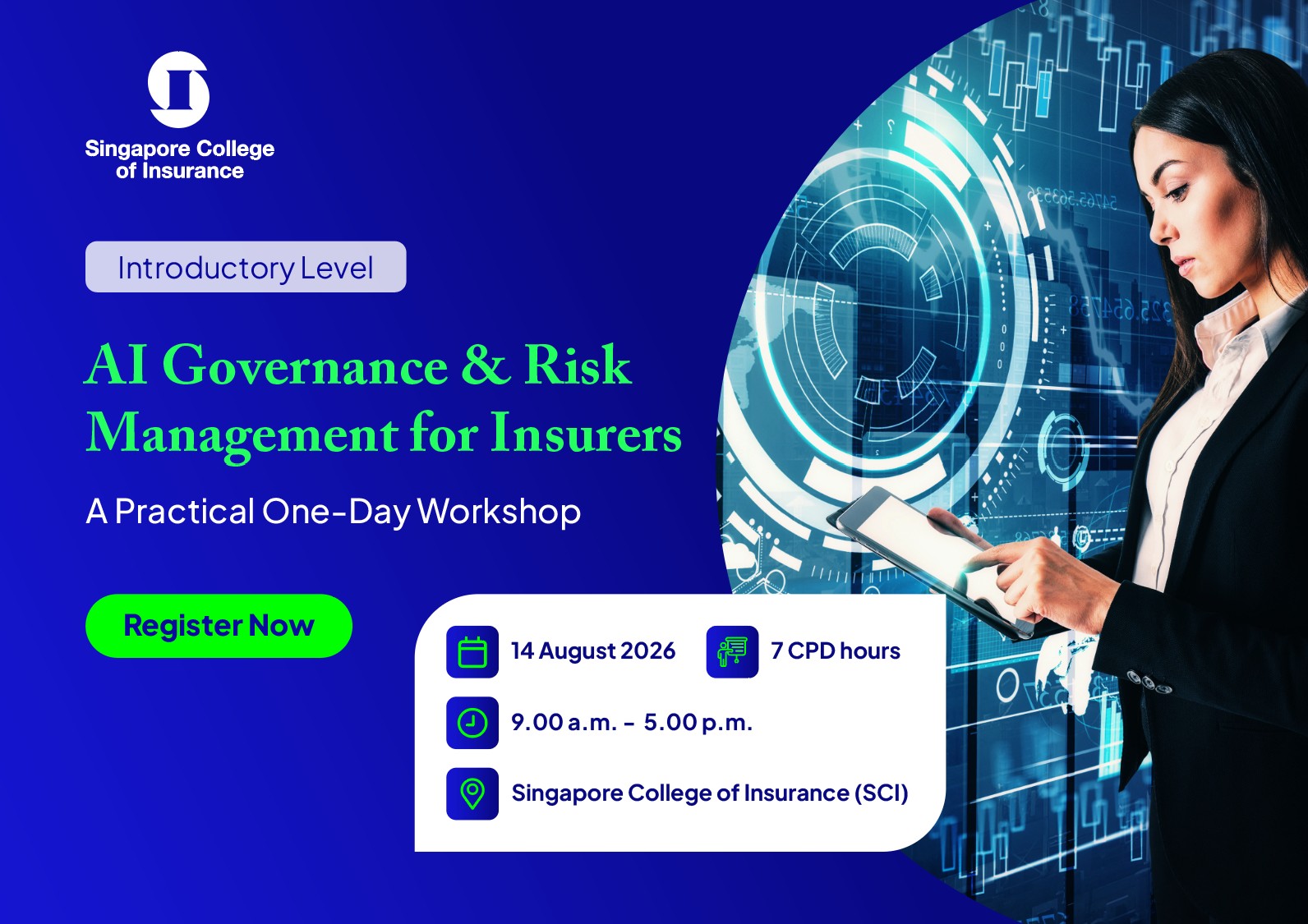
AI Governance & Risk Management for Insurers

Programme Highlights

As artificial intelligence becomes increasingly embedded across underwriting, claims, pricing, and customer engagement, insurers face growing expectations to manage associated risks responsibly. This one-day workshop provides a practical and accessible understanding of AI governance and risk management, anchored in the Monetary Authority of Singapore’s proposed AI Risk Management Guidelines (AIRG).

Participants will start with a non-technical primer on AI—from machine learning to emerging agentic systems—before exploring key risk areas, including operational, ethical, regulatory, and reputational risks. Through interactive case vignettes, they will apply risk identification concepts to real-world insurance scenarios.

The programme also examines Singapore’s approach within the global AI governance landscape, highlighting key regulatory trends. In addition, the programme focuses on implementation, covering governance frameworks, materiality assessments, alignment with ISO 42001, and controls across the AI lifecycle.

By the end of the workshop, participants will gain practical insights and a clear roadmap to operationalise AI governance within their organisations.

7 CPD Hours
Mode: Face-to-face training
Date: 14 August 2026
Time: 9.00 a.m. to 5.00 p.m.

For Whom

  • Insurance professionals involved in underwriting, claims, product development, or digital transformation
  • Risk management, compliance, and governance professionals within insurers and reinsurers
  • Senior managers and decision-makers responsible for AI adoption or oversight
  • Professionals seeking to understand MAS' proposed AI Risk Management Guidelines (AIRG) and their practical implications
  • Non-technical stakeholders who require a structured understanding of AI risks and governance

Key Learning Objectives

At the end of the programme, participants should be able to:

  • Understand key AI concepts, including machine learning and emerging agentic AI systems
  • Identify and assess key risks associated with AI adoption in insurance
  • Interpret MAS' proposed AI Risk Management Guidelines (AIRG) and their relevance to insurers
  • Compare global AI governance frameworks and regulatory developments
  • Apply structured approaches to AI risk assessment using practical scenarios
  • Design and implement AI governance frameworks within their organisations
  • Conduct materiality assessments, and understand standards such as ISO 42001
  • Establish appropriate controls across the AI lifecycle, from development to deployment and monitoring

Programme Outline

  • AI Technology Primer – ML to Agentic AI
    • Overview of AI, machine learning, and generative AI
    • Evolution towards agentic AI systems
    • Evolution of risks from machine learning to agentic AI
    • Applications of AI in insurance
  • The AI Risk Landscape
    • Key AI risk categories and challenges (model & data, technology & cyber, third-party etc.)
    • Risk implications for insurers
  • Risk Assessment Vignettes (Group Exercise)
    • Scenario-based risk identification
    • Assessing AI use cases in underwriting/claims
    • Group discussion and insights
  • The Global AI Governance & Risk Management Landscape
    • Overview of global frameworks and regulatory approaches
    • Key trends in AI governance
    • Implications for insurers operating across jurisdictions
  • Singapore’s AI Governance & Risk Management Journey
    • MAS FEAT Principles and proposed AI Risk Management Guidelines (AIRG)
    • Regulatory expectations and industry direction
    • Practical implications for insurers
  • Structuring AI Governance & Risk Management
    • Governance frameworks and accountability structures
    • Roles and responsibilities across functions
    • Integrating AI governance into enterprise risk management
  • Materiality Assessment & ISO 42001 (Group Exercises)
    • Understanding materiality in AI risk
    • Applying materiality assessment through case scenarios
    • Introduction to ISO 42001
    • Assessing ISO 42001 certification against AI risk management
  • AI Lifecycle Controls
    • Controls across design, development, deployment, and monitoring
    • Model validation, documentation, and auditability
    • Ongoing monitoring and incident management
  • Q&A and Assessment
    • Consolidation of key learning points
    • Participant assessment and discussion

Programme Leader

Mr. Gary Ang led AI risk supervision at the Monetary Authority of Singapore (MAS), where he was responsible for developing Singapore's first AI risk management guidelines for the financial sector. He was previously division head for investment risk management, overseeing risk management of Singapore's foreign reserves, and also has deep expertise in Basel capital rules, banking and capital market policies, and model risk supervision.

Gary holds a PhD in Computer Science. His research focused on deep learning for networks, time series, and multimodal data, and he has published at leading venues including ACL and ACM conferences. He also holds Masters’ degrees in Financial Engineering and Knowledge Engineering from NUS, as well as an Electrical Engineering degree from the University of Toronto.

Programme Fee

Full Course Fee: S$545.00  (inclusive of 9% GST)

A 10% Group Discount is also applicable for organisations registering a minimum of three participants.

Net Course Fee: S$395.00 (incl. of 9% GST and after 30% FTS funding)

For Singapore Citizens below 40 years old and Singapore Permanent Residents

Net Course Fee: S$195.00 (incl. of 9% GST and after 70% FTS funding)

For Singapore Citizens aged 40 years old and above

This course is recognised under the Financial Training Scheme (FTS) and is eligible for FTS claims subject to all eligibility criteria being met.

Please note that in no way does this represent an endorsement of the quality of the training provider and course. Participants are advised to assess the suitability of the course and its relevance to his/her business activities or job roles.

The FTS is available to eligible entities based on the prevalent funding eligibility, quantum and caps.  FTS provides up to 70% course fee subsidy support for direct training costs subject to a cap of S$500 per candidate per course subject to all eligibility criteria being met.

Find out more on www.ibf.org.sg.

Register Now
Last Updated Date:
16/6/26

AI Governance & Risk Management for Insurers

View Brochure